
How to Search Orange County Court Records
The main tool is my eClerk, the records portal run by the Orange County Clerk of the Circuit Court and Comptroller. It covers traffic, civil, criminal, family, and probate dockets together. Online docket information is available for most cases filed from about 1990 to the present. Documents are available from 2009 to the present for most case types, though confidentiality rules can block some files. The portal caps each result list at 500 records, so a broad name search returns only the first page.
A search needs a few inputs ready. Pick a case type or use Search All. Type a full first and last name, or use a case number, citation number, or business name. Date searches need both a start and end date. The system asks anonymous users to clear a CAPTCHA before each search, and signed-in users skip that step.
The full search walkthrough lives on the Orange County court records page. The short version is below.
The clerk publishes a clean landing page at myeclerk.myorangeclerk.com that links to every search tool the public can use.
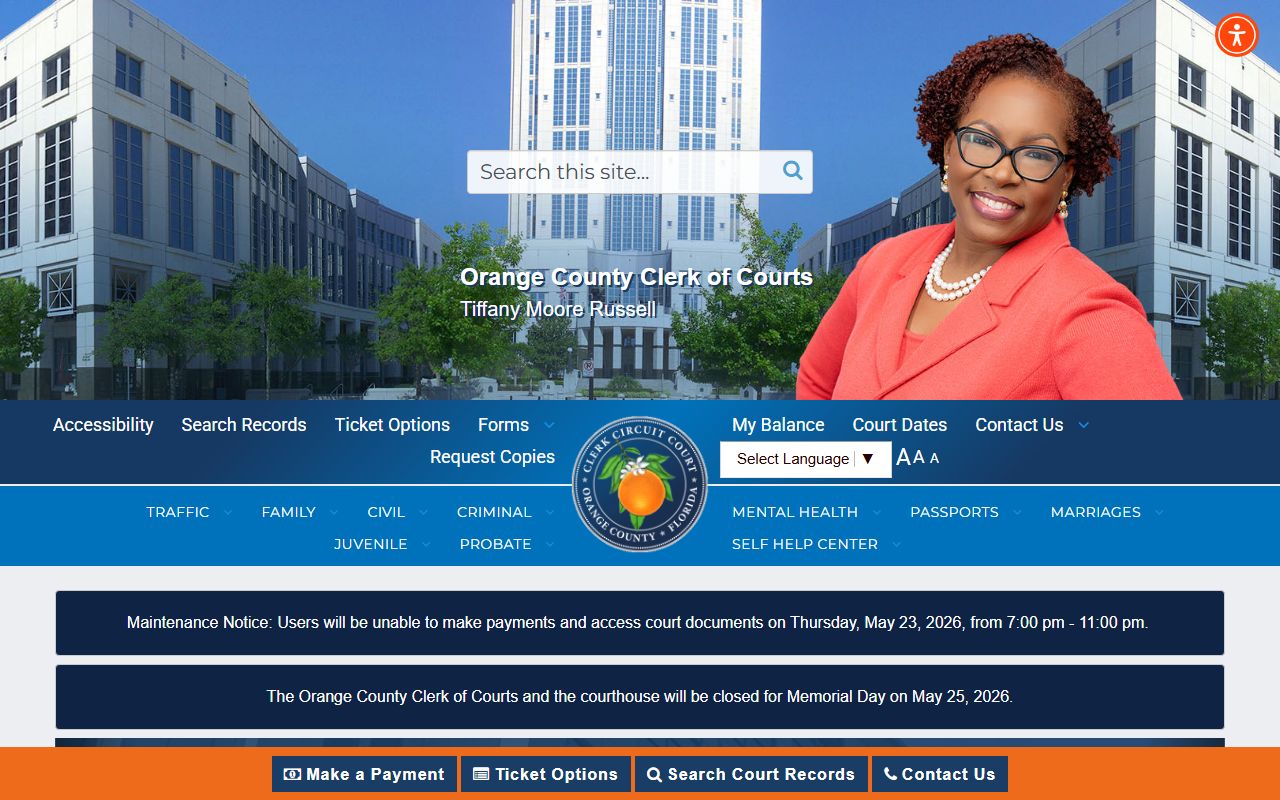
That same landing page shows links to records search, marriage application, hearing schedule, form packets, and case balance.
- Open the my eClerk search form.
- Pick a case type or choose Search All.
- Type a full first and last name, or use a case number or citation number.
- For date searches, set both a Date From and a Date To.
- Clear the CAPTCHA if you are not signed in.
- Open a result to view docket entries and any public documents.
The Orange County Judicial System
Orange County sits inside the Ninth Judicial Circuit, which also serves Osceola County. The state court hierarchy runs from the Florida Supreme Court down through the District Courts of Appeal, the Circuit Courts, and the County Courts. Felony cases, family law, probate, guardianship, juvenile, and larger civil matters route to Circuit Court. Misdemeanors, traffic, small claims, eviction, and lower-dollar civil disputes go to County Court.
The Orange County Courthouse at 425 North Orange Avenue in Orlando is the main trial building for both levels. The case flow below shows how a typical case can move up.
Case flow: County Court › Circuit Court › District Court of Appeal › Florida Supreme Court
The Ninth Circuit's judge directory lists active assignments and division work for both counties. Treat that page as the source of truth because assignments shift each year.
| Court | Jurisdiction | Case Types |
|---|---|---|
| Circuit Court | Felony, family, probate, larger civil | Criminal Felony, Family, Probate, Civil >$50,000 |
| County Court | Misdemeanor, traffic, small claims, eviction | Misdemeanor, Criminal Traffic, Traffic, Civil <$50,000 |
| District Court of Appeal | Appeals from circuit and county courts | Civil, criminal, and family appeals |
| Florida Supreme Court | State-level review | Death penalty, constitutional, certified questions |
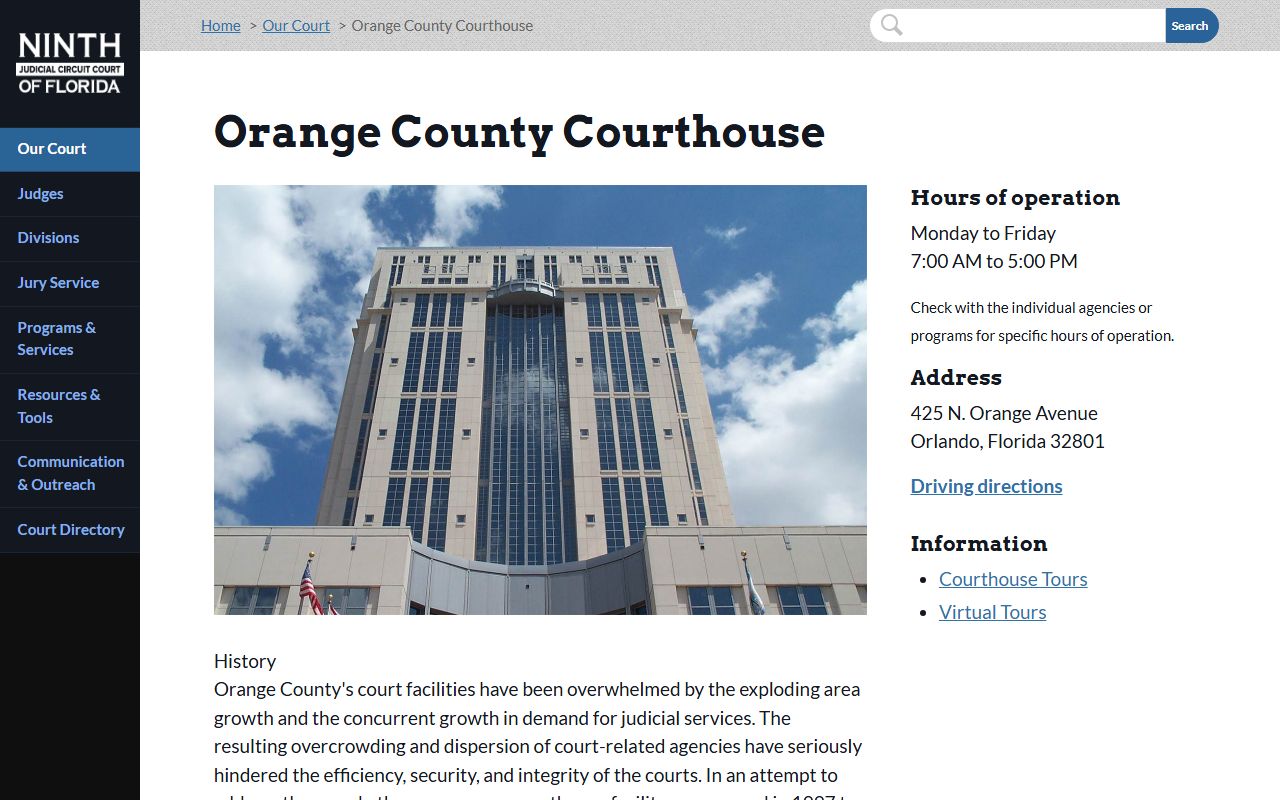
That Ninth Circuit page lists divisions, mailing details, and a brief courthouse overview.
Orange County Courthouse and Clerk Branches
The Orange County Courthouse is in downtown Orlando, near the county administration center, the State Attorney's Office, and the Public Defender. The clerk also runs branch offices for services like marriage licensing and certified copies, listed on the official clerk branch locations page.
Booking & Release Center
3855 John Young Parkway
Orlando, FL 32839
(407) 836-3400
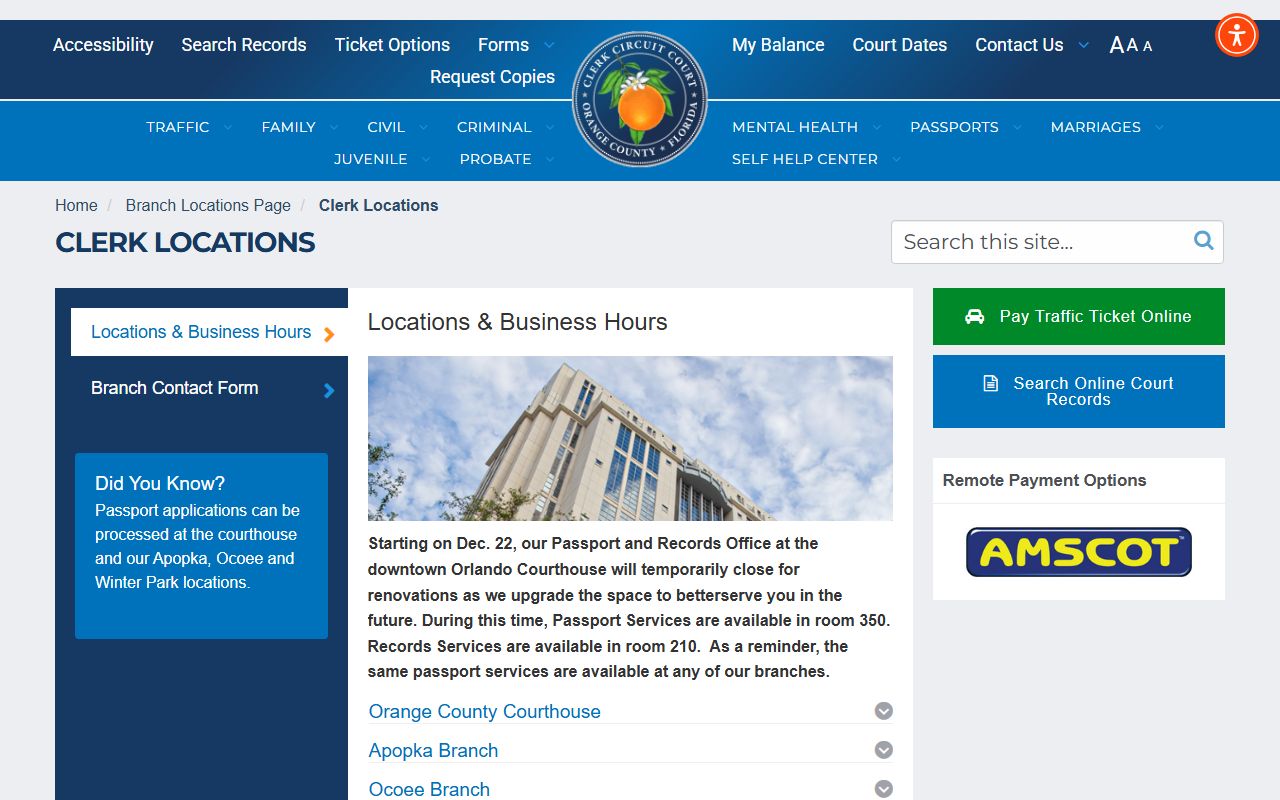
The branch page lists each clerk office that handles in-person services across the county.
Types of Court Records Available in Orange County
The clerk groups Orange County Court files by case type. The my eClerk dropdown lists more than one hundred categories, but most public users look for one of the broad groups below. Each group is searched on the same form. Confidential records may not appear, and some documents are blocked from anonymous view.
- Criminal records cover Criminal Felony (CF), Misdemeanor (MM), Criminal Traffic (CT), Fugitive Warrant cases, and county or municipal ordinance cases. See Orange County arrest records.
- Civil records cover auto negligence, breach of contract, eviction, foreclosure, replevin, quiet title, and other money or property disputes.
- Family records cover dissolution of marriage, paternity, child support, time-sharing, injunctions, and adoption-related filings. See divorce records.
- Probate records cover formal administration, summary administration, guardianship, trusts, and wills for safekeeping. See Orange County probate records.
- Traffic records cover Traffic Infractions (TR), Toll Infraction, and Criminal Traffic (CT) cases.
- Juvenile and mental health cases are listed as categories but mostly blocked for general public users.
Risk Protection Orders, sealed cases, and expunged records have their own access rules.
What Orange County Court Records Show
An open docket usually shows the case number, filing date, party names, attorneys of record, judge or division, status, docket entries, and hearings on the calendar. Documents are linked when public access is allowed under Florida Supreme Court Administrative Order AOSC16-14.
| Field | What It Shows |
|---|---|
| Case Number | Year, case type code, and a sequence, for example 2025CF010784AO. |
| Filing Date | Date the case was opened with the clerk. |
| Parties | Plaintiff, defendant, petitioner, respondent, or estate. |
| Charges or Cause | Criminal charges, civil claims, or petition type. |
| Docket Entries | Filings, motions, orders, hearings, and judgments in date order. |
| Disposition | Outcome at the trial level, such as judgment, plea, or dismissal. |
| Sentence or Judgment | Sentence, restitution, civil judgment, or final order text. |
| Hearings | Date, time, courtroom, hearing type, and assigned judge. |
| Case Balance | Court fines, fees, and restitution still owed. |
Personal data such as Social Security numbers, bank accounts, victim addresses, and minor names is redacted on public views. The Orange County court dockets page explains how docket entries differ from full case documents.
Public Access Laws for Orange County Court Records
Florida treats court records as public by default. The court branch follows its own rule for access, while county and city offices follow the state's open-records statute. The result is that most Orange County Court cases are searchable, but some documents are blocked or redacted.
Key Statutes:
Florida Statutes Chapter 119. The state public records law that covers county and city agency records, with set fees, response duties, and listed exemptions.
Florida Rule of Judicial Administration 2.420. The court branch rule that defines confidential court records and how to ask a judge to seal or unseal a file.
Florida Statutes § 943.0585. The expunction statute. Qualifying criminal cases can be removed from ordinary public access after a court order.
Florida Statutes § 943.059. The sealing statute. Sealed records stay hidden from the public but remain available to listed agencies.
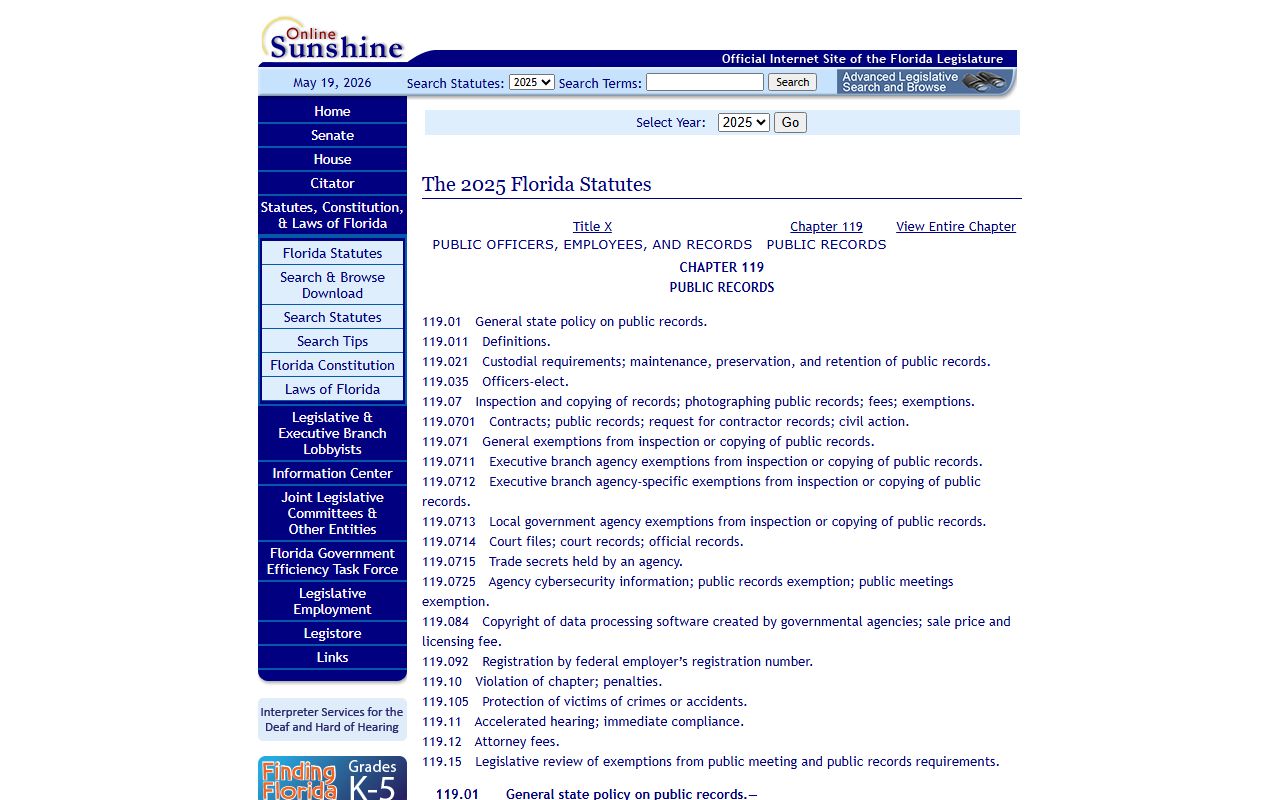
Chapter 119 is the main statute behind any open records request to a county or city office.
Records That Are Restricted or Confidential
Some Orange County Court files do not show up for the general public. Juvenile records are limited by Florida Statutes § 985.04. Adoption files are protected by Florida Statutes § 63.162. Mental-health clinical records sit under Florida Statutes § 394.4615. The clerk warns on the search form that mental-health case searches will not return public results, except Risk Protection Orders after service to a registered user.
Sealed and expunged cases sit out of public view under sections 943.059 and 943.0585. A docket entry can stay public while the document is blocked. Domestic-violence injunctions can show case activity while still hiding the victim address. Personal data such as Social Security numbers and minor identifiers is redacted on public dockets as a routine step.
To request a record that is blocked, parties usually file a motion in the original case or work through counsel. Self-represented filers should review the clerk's form packets first.
Specialty Courts in Orange County
The Ninth Judicial Circuit runs problem-solving courts that mix court oversight with treatment. The official problem solving court page is the source of truth for active programs.
Adult Drug Court hears substance-use cases that meet eligibility rules. The program adds drug testing, treatment plans, case management, and review hearings to a regular case. Veterans Court serves eligible defendants with military service whose case ties back to substance use, trauma, or reintegration needs. Mental Health Court connects defendants who need treatment with judges, case managers, and providers who track each step.
Eligibility for any specialty court turns on charge type, criminal history, clinical assessment, and program capacity. The State Attorney's Office, the Public Defender, and the assigned judge each play a role at intake.
Orange County Sheriff and Jail
The Orange County Sheriff's Office handles arrests, warrants, and patrol in the unincorporated parts of the county and in many of the smaller cities. The Sheriff also runs the warrant unit at ocso.com. Orange County Corrections, a separate county department, runs the jail. The jail roster lives at netapps.ocfl.net/BestJail and refreshes every 30 minutes.
The campus on John Young Parkway includes five direct-supervision facilities and the Main Facility Jail, with a combined 3,205 listed beds. Visitors should use the Orange County inmate records page for the full roster walkthrough and the warrant records page for active warrant guidance. Released inmates leave the current roster right away, so verification can shift to the released inmates page.

The Sheriff's site links out to warrant info, arrest reports, and crime statistics.
Marriage, Divorce, and Probate Records
Marriage licenses come from the Orange County Clerk's online marriage application portal. Divorce filings are searched under family case records and the Dissolution of Marriage case type. Probate work in Florida runs through the Probate Division of the Circuit Court rather than a separate elected probate court. The marriage and divorce records and probate records pages cover each step.
- Testator
- The person who made the will.
- Executor
- The person named in the will to settle the estate.
- Intestate
- A death with no valid will on file.
- Guardianship
- Court-ordered care of an adult or minor.
- Conservatorship
- Court-ordered control of an adult's property.
Orange County Court Records Fees
The clerk charges set fees for copies, certified copies, search work, and marriage licenses. Amounts are fixed by state law and can change, so the clerk's official page is the place to confirm a current figure. Payment runs online for traffic and criminal cases at the clerk payment page, or in person at a branch office.
| Service | How the Fee Is Set |
|---|---|
| Plain copies | Per-page rate set by state law |
| Certified copies | Certification charge plus a per-page rate |
| Records search | Charged per name or per year searched |
| Marriage license | State-set fee, with a discount for a premarital course |
| Traffic or criminal payment | Paid online or by mail to the clerk |
Always confirm the current amount on the clerk's official page before paying.
How to Interpret Orange County Court Records
Case numbers carry meaning. A code like 2025CF010784AO breaks down as year, case type code, sequence, and division suffix. CF stands for Criminal Felony. MM is Misdemeanor. CT is Criminal Traffic. TR is Traffic Infraction. CO and MO mark County or Municipal Ordinance cases. Reading the suffix helps confirm which court holds the file.
Docket lines also use short codes. Arraignment, plea, motion, order, judgment, and disposition each show up on their own line with a date. A charge is what the state filed, while a conviction is the final outcome of guilt. Many cases end in dismissal, deferred adjudication, or a plea to a lesser count, so a charge alone does not equal a conviction. The clerk also publishes a public glossary of terms for quick lookup.
Accuracy and Record Limitations
Online court data carries lag. Filings move into the system after intake. Sealed cases drop from public view after the judge signs the order. Inmate listings refresh every 30 minutes but show only people in custody right now. Driver-record consequences flow to the state agency on a separate clock.
Note: Confirm any case detail with the clerk's office or the assigned division before relying on it for a legal step or background decision.
History of Orange County Courts
The Orange County Courthouse on North Orange Avenue is the regional legal center for Orlando and the wider Central Florida area. The court system runs under Florida's Article V judiciary, which sets a Circuit Court and a County Court at each judicial circuit. The Ninth Judicial Circuit groups Orange and Osceola counties together. Online docket coverage goes back to about 1990, while online documents go back to 2009 for most case types. Florida Supreme Court Administrative Order AOSC16-14 set the rules that let the Orange County Clerk give the public broad electronic access while keeping confidential filings out of view.
Frequently Asked Questions
How do I search Orange County court records online?
Use the my eClerk records search at myeclerk.myorangeclerk.com/Cases/Search. You can search by case type, first and last name, business name, case number, citation number, or date range. Name searches need both first and last name. Anonymous users must clear a CAPTCHA before each search.
What years are available online?
Online docket information is available for most cases filed from about 1990 to the present. Documents are available from 2009 to the present for most case types, subject to confidentiality and access rules. Older paper records may need a clerk request or a courthouse visit.
Where do I find Orange County inmates?
The current inmate roster is at netapps.ocfl.net/BestJail. Last name is required. The roster updates every 30 minutes and lists only people in custody right now. Released inmates drop off the list, so use VINE or call (407) 836-3400 to confirm release.
More answers live on the Orange County Court Records FAQ page.