
Arrest Records in Orange County
An arrest record starts at booking. When the Orange County Sheriff's Office or a city police agency arrests someone, county corrections books the person and logs the charges. The record lists the name, the booking number, the charges, the bond, the arresting agency, and a booking photo. Orange County Corrections posts this data on its public inmate database and refreshes it every 30 minutes. The page warns that being listed does not mean a person is guilty.
An arrest record is only the first step. Once the State Attorney files charges, a criminal court case opens with the clerk and gets its own docket. The arrest record sits with the Sheriff and corrections, while the court record sits with the clerk. For the full case history, plea, and disposition, use the Orange County court records page. This page focuses on the arrest and booking side.
How to Search Orange County Arrest Records
The fastest tool is the county jail roster at netapps.ocfl.net/BestJail. Last name is required and first name is optional. The roster shows people in custody right now, with charges, bond, and a booking photo. It does not keep people after release. For a recent arrest that has not gone to court yet, the roster and the daily booking list are the main sources.
- Open the Orange County Corrections inmate database.
- Type the last name, and add a first name to narrow results.
- Open a result to view charges, bond, and booking detail.
- For court history, move to the clerk's case search by name.
For a charge that has reached court, the clerk's my eClerk system holds the criminal case. Search Criminal Felony (CF), Misdemeanor (MM), or Criminal Traffic (CT) by name. For a statewide criminal history, the Florida Department of Law Enforcement runs a paid background-check service separate from any county tool.
Arrest Records vs. Criminal Court Records
These two records come from different offices and start at different times. The arrest record is created at booking by law enforcement. The court record opens when the State Attorney files a charge. One can exist without the other. A person can be booked and released with no charge filed, or charged by summons with no booking at all.
| Arrest Record | Criminal Court Record | |
|---|---|---|
| Source | Sheriff and police, county corrections | Clerk of the Circuit Court |
| Created When | At booking | When charges are filed |
| Contents | Booking data, charges, bond, mugshot | Pleadings, motions, plea, disposition |
| Where to Search | Jail roster, daily booking list | my eClerk case search |
Charges vs. Convictions
A charge is an accusation. A conviction is a finding of guilt. The two are not the same, and many cases end without a conviction. A charge needs only probable cause to file. A conviction needs proof beyond a reasonable doubt or a guilty plea. Cases close in many ways, such as dismissal, a plea to a lesser count, or deferred adjudication.
| Charge | Conviction | |
|---|---|---|
| Stage | Accusation at filing | Verdict or plea |
| Burden of Proof | Probable cause | Beyond a reasonable doubt |
| Outcome | Case is still open | Guilt is established |
| Public Record | Yes, on the docket | Yes, on the docket |
The State Attorney's Office for the Ninth Judicial Circuit decides what charges to file.

The office handles charging, plea talks, and trial work for Orange and Osceola counties.
Sealed vs. Expunged Records
Florida lets people seal or expunge some criminal records. Sealing hides a record from the public but keeps it for listed agencies. Expunction goes further and removes the record from ordinary access. Sealing is set by Florida Statutes § 943.059. Expunction is set by Florida Statutes § 943.0585. Most petitions start with a certificate of eligibility from the Florida Department of Law Enforcement.
| Sealed | Expunged | |
|---|---|---|
| Visibility | Hidden from the public | Removed from ordinary access |
| Law Enforcement | Limited access remains | Very limited access remains |
| Statute | § 943.059 | § 943.0585 |
| First Step | FDLE certificate of eligibility | FDLE certificate of eligibility |
The text of Florida Statutes § 943.0585 sets out the expunction process.
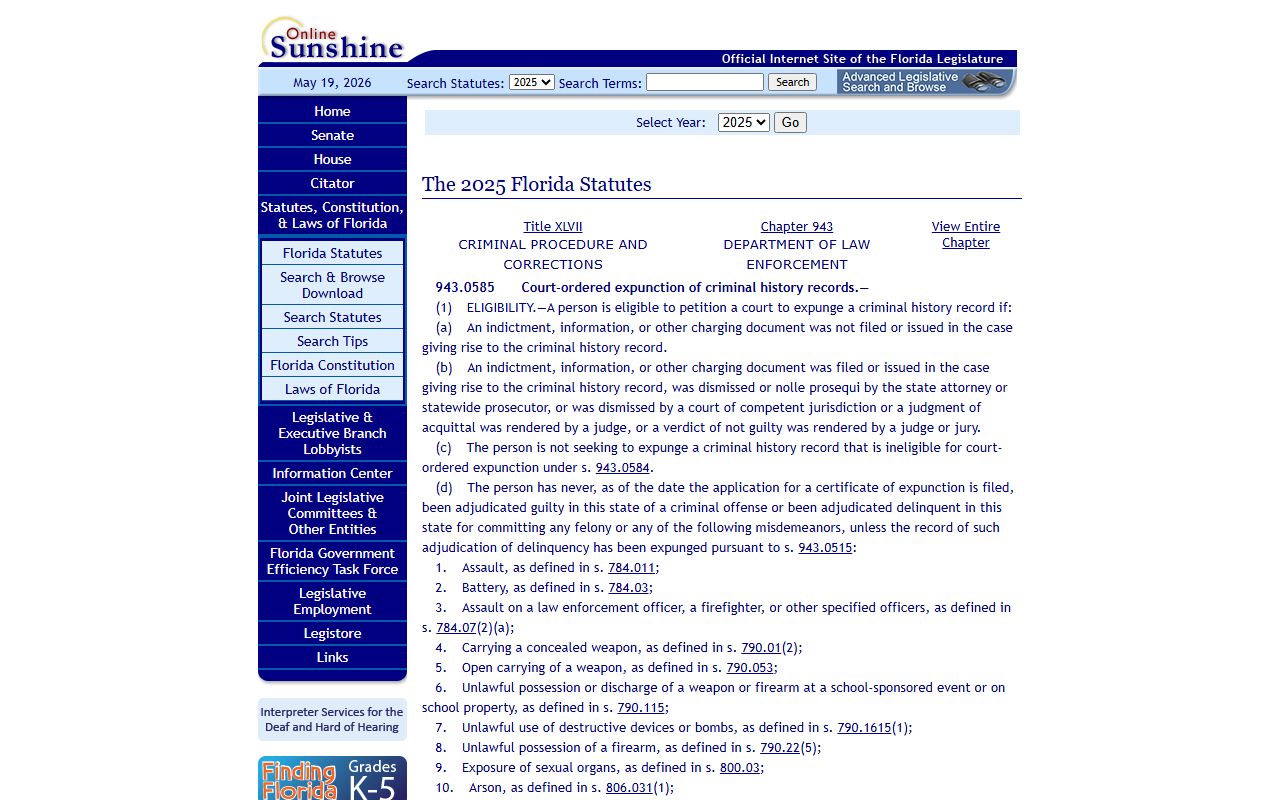
The statute lists eligibility limits, agency duties, and the exceptions where a record stays available.
Mugshots and Booking Photos
The county jail roster shows a booking photo for each person in custody. The photo comes back with the booking record and drops off the public list once the person is released. The roster also lists race, gender, age, last known location, cell, date booked, number of holds, and the charges with bond. A yellow immigration-hold label appears when a federal hold is set.
Booking photos are public while a person is in custody, but they are not a finding of guilt. Use them to confirm an identity or a booking, not to judge an outcome. For the court result, follow the case on the clerk's docket.
Statewide Criminal Records Search
A county search shows local arrests and cases. A statewide search shows convictions and custody across Florida. The Florida Department of Corrections runs an offender search for people in state prison or on supervision. The Florida Department of Law Enforcement runs the official statewide criminal-history check for a fee. These are separate from any Orange County tool.
The Florida Department of Corrections offender search covers state custody and supervision.
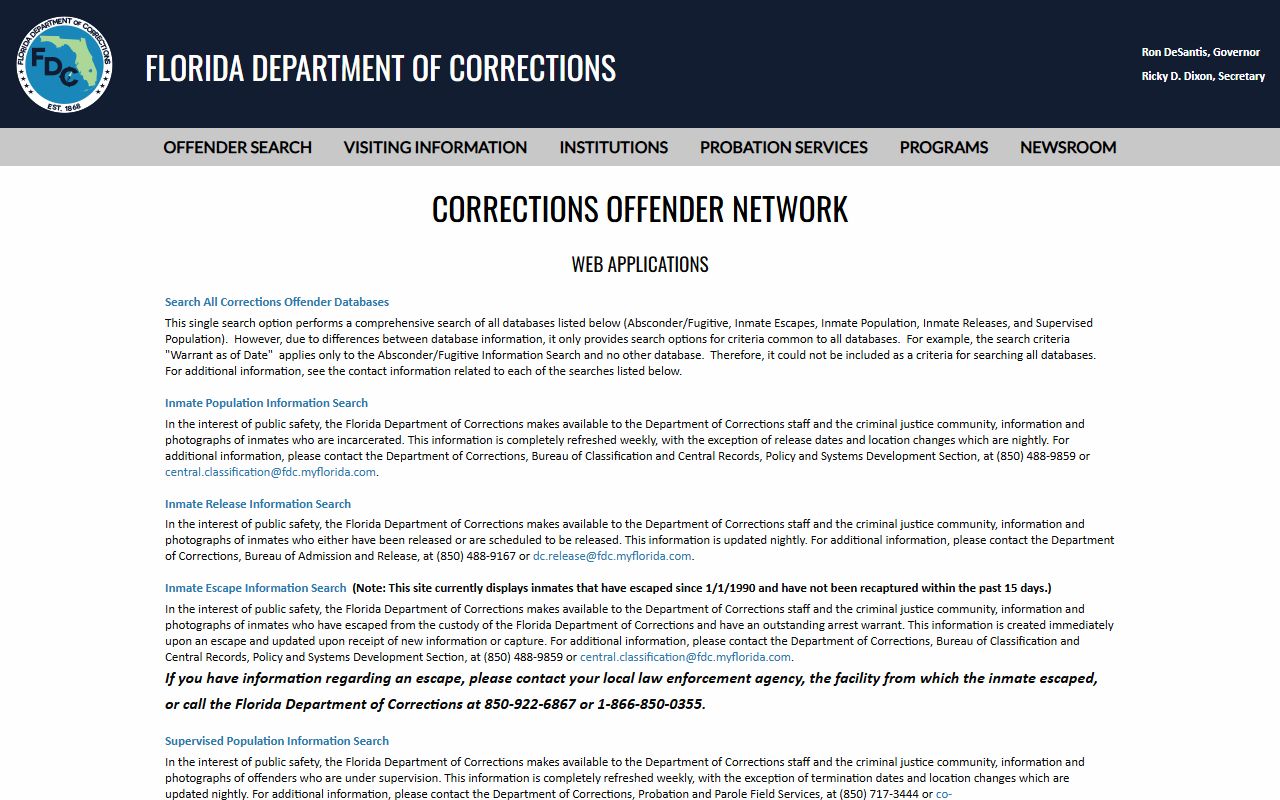
The same menu links to inmate population and release searches across the state.
Background Check Considerations
A casual lookup and a formal background check are not the same. A jail roster or docket search is fine for personal use. A background check used for hiring, housing, or credit must follow the federal Fair Credit Reporting Act and use a licensed provider. The county roster and the clerk's case search are public-service tools, not consumer reports.
Important: This site is not a consumer reporting agency under the FCRA, and its data may not be used for hiring, housing, credit, or insurance decisions.
Restricted Criminal Records in Orange County
Some criminal records stay out of public view. Juvenile justice records are limited by Florida Statutes § 985.04. Sealed and expunged cases drop from public access under court order. Ongoing investigation files can be withheld until a case is filed or closed. A capias or fugitive-warrant matter may show in the jail charge data once an arrest is made. For active-warrant questions, see the Orange County warrant records page.
Daily Booking List and Recent Arrests
Orange County Corrections posts a daily booking list for people booked during a 24-hour period that starts at midnight. It is a useful tool for recent arrests that may not yet show a court case. The list is separate from the live roster, which shows only people still in custody. A first-appearance list runs daily and shows people set to see a judge for an initial bond review.
First appearances happen seven days a week, including holidays. At the hearing the judge tells the person the new charge and the bond status for that charge. For full booking detail and the live roster walkthrough, use the Orange County inmate records page.
Orange County Arrest Records Questions
Does an arrest record mean a person was convicted?
No. An arrest record only shows that a person was booked on a charge. The jail page states that being listed does not mean guilt. A conviction requires a plea or a verdict in court. Many cases end in dismissal or a plea to a lesser count, so always check the court docket for the result.
How long does an arrest stay on the jail roster?
The live roster shows only people in custody right now. Once a person is released, the record drops off the current list. The daily booking list still records the booking for that day. For a case that reached court, the clerk's docket keeps a lasting record under public access rules.